
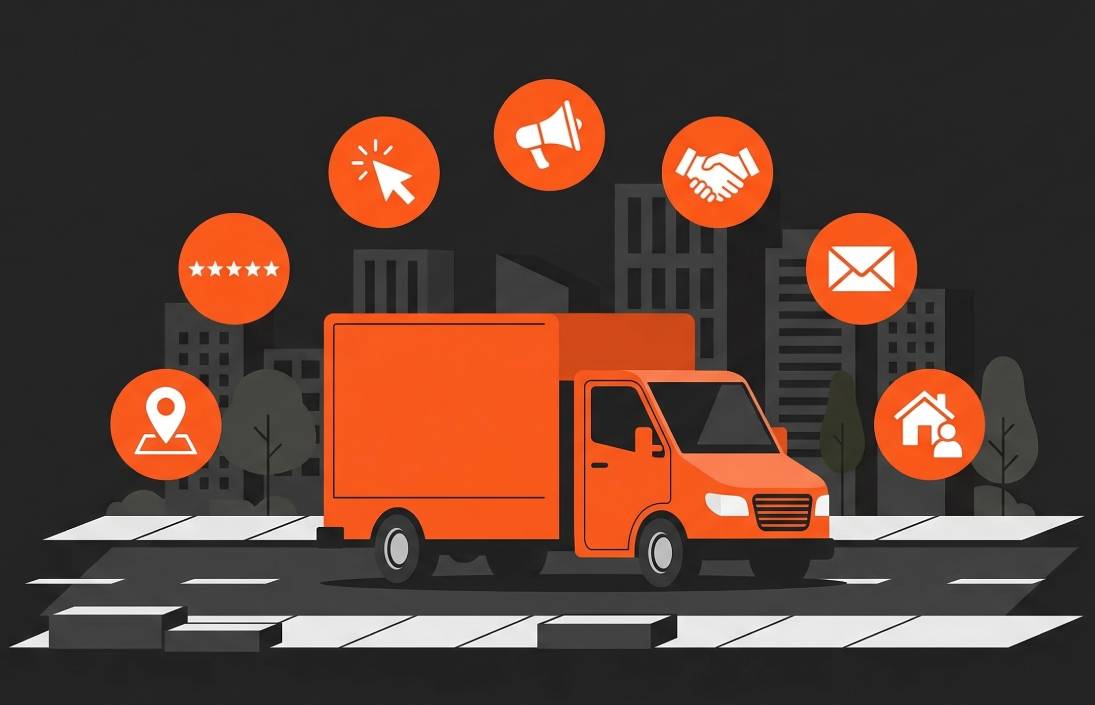
7 Marketing Strategies for Moving Companies That Actually Work
Generic marketing advice doesn’t work for movers. Here’s what does – based on real campaigns, real budgets, and real results.
Search “marketing strategies for small business” and you’ll get the same list every time. Post on social media. Build an email list. Run some ads. Start a blog.
Not wrong. Just useless without context.
Moving is a specific business with specific buying behavior. Customers don’t follow you for months before hiring you – they need a mover in the next two to four weeks and they make a decision fast. Your marketing has to meet them at that moment, build trust quickly, and make it easy to choose you over the five other companies they’re looking at.
These are the seven strategies that consistently move the needle for moving companies looking to scale beyond $1M/year.
1. Own Your Google Business Profile
Before someone visits your website, before they see your ads, they see your Google Business Profile. It’s the listing that appears in Google Maps when someone searches “movers near me” – and it’s completely free.
Most moving companies have a profile but treat it like a set-and-forget directory listing. The ones that win treat it like a marketing channel:
- 50+ Google reviews at 4.8 stars or above
- Photos of the team, trucks, and completed jobs updated regularly
- Weekly GBP posts (a tip, a promotion, a recent job)
- Every field completed – services, service area, hours, attributes
A fully optimized GBP in most US markets generates consistent inbound calls at zero ad spend. It’s the highest-ROI starting point for any moving company.
2. Build a Website That Converts Traffic Into Leads
Your website isn’t a brochure. It’s a salesperson that works 24 hours a day. The question is whether it’s doing its job.
A converting moving company website has a few non-negotiables: it loads in under 3 seconds, the phone number and quote form are visible without scrolling, and the copy speaks directly to the customer’s anxiety – not just your service list.
We rebuilt their site with a simplified 5-field quote form and a floating CTA button. Conversions increased by 262%. The traffic was already there – the old website was turning it away.
If your website has a complex multi-step quote form, slow load times, or no visible trust signals above the fold, fixing those three things alone can double your conversion rate before you spend another dollar on ads.
3. Run Google Ads to Your Own Landing Pages
Google Ads is the fastest way to generate exclusive moving leads – but the key word is exclusive. When you run ads that send traffic to your own website, every lead belongs to you. No shared pipelines, no competing with four other movers for the same customer.
The moving companies that scale to $1M+ with Google Ads aren’t just running generic campaigns. They’re targeting by neighborhood, pre-qualifying leads in the ad copy, and tracking every conversion back to a specific keyword and campaign.
Our Google Ads clients average $54 cost per lead – maintained consistently even as budgets scaled by 200-400%. That’s what proper targeting and conversion tracking looks like.
4. Collect Google Reviews Systematically
Reviews aren’t just social proof – they directly affect where you rank on Google Maps and how much your ads cost. A moving company with 200 reviews at 4.8 stars will outrank a competitor with 30 reviews almost every time, regardless of how long either has been in business.
The system is simple: ask on moving day when the customer is happy and relieved, send a follow-up text within 24 hours with a direct link to your review form, and respond to every review that comes in. Five new reviews a month compounds into a serious competitive advantage within a year.
5. Stop Buying Shared Leads – Build a Referral Program Instead
Pay-per-lead platforms put you in a bidding war with four other movers for the same customer. A referral program turns your happiest customers into a sales channel that sends people directly to you.
A simple structure works: offer past customers a $50 gift card for every new booked job they refer. Moving is a life event people talk about. When a friend asks “do you know a good mover?”, you want your customer to have a specific reason to mention you – and a direct link to make it easy.
High ROI, low cost, and it builds on the trust you’ve already earned. Most moving companies don’t have a formal referral program. That’s the opportunity.
6. Set Up a Post-Job Email Sequence
Most moving companies do the job, collect payment, and never contact the customer again. That’s a missed opportunity on three fronts: repeat business, referrals, and reviews.
A simple three-email sequence sent after every completed job covers all three:
- Email 1 (same day): Thank them for choosing you. Make them feel good about the decision.
- Email 2 (3 days later): Ask for a Google review. Include the direct link — one click, no friction.
- Email 3 (30 days later): Check in, remind them about your referral program, and offer a discount on their next move or storage need.
People move more than once. They also talk about their move to everyone they know for weeks afterward. A three-email sequence costs nothing to set up and works automatically once it’s built.
7. Build Local Referral Partnerships
Real estate agents, property managers, and apartment complex leasing offices are in constant contact with people who need movers. One solid partnership with a busy local realtor can send five to ten booked jobs a month – consistently, at zero ad spend.
The approach is straightforward: identify the top 20 real estate agents in your market by transaction volume, reach out with a simple value proposition (reliable mover their clients can trust, referral fee for every booked job), and follow up. Most agents don’t have a go-to mover they actively recommend – that’s the gap you’re filling.
Property managers are equally valuable. A single apartment complex with high turnover can become a steady source of move-in and move-out jobs year-round. Build three to five of these relationships and you’ve created a lead source that no competitor can buy their way into.
These seven strategies work best as a system, not in isolation. Google Ads fills the calendar now. Your GBP and reviews build the pipeline passively. A converting website makes every channel more efficient. Referrals and partnerships lower your cost per acquisition over time.
If you’re not sure which of these to build first for your specific situation, that’s exactly what a marketing strategy for your moving company is designed to answer.
Not Sure Where to Start?
Book a free 30-minute strategy call. We’ll look at where your moving company stands and tell you exactly which of these to build first.
Book a Free Call →