
Moving Company Website Design: What Actually Converts
Most moving company websites are digital brochures. Here’s what separates the ones that generate leads from the ones that just take up space on the internet.
If you asked most moving company owners what their website is for, they’d say something like “so people can find us” or “to look professional.” Both are true – but neither is the real job.
Your website is a conversion machine. Its only purpose is to take someone who is considering hiring a mover and give them every reason to choose you – right now, before they open another tab.
Most moving company websites fail at that job completely. Not because they look bad, but because they’re built to inform rather than to convert. Here’s what the difference looks like in practice.
The 3-Second Rule
When someone lands on your website, you have about three seconds before they’ve formed an opinion. In that window, they’re asking three questions unconsciously:
- Is this a real, legitimate business?
- Do they serve my area?
- How do I get a quote?
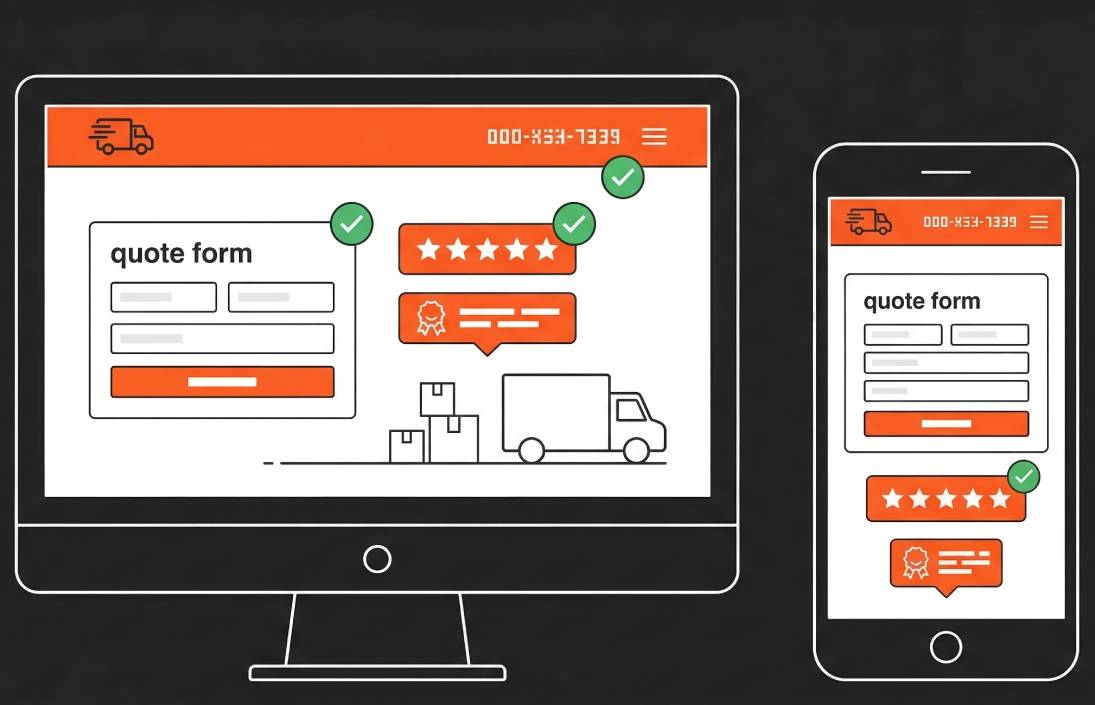
If your homepage doesn’t answer all three without scrolling, you’re losing people before they’ve read a single word of your copy. Phone number visible in the header. City or service area mentioned in the hero. A quote form or CTA button above the fold. That’s the minimum.
Quick test: Open your website on your phone right now. Can you see a phone number, your service area, and a way to request a quote without scrolling? If not, you’re losing leads on mobile – where the majority of moving searches happen.
Speed Is Not Optional
A moving company website that loads in 5 seconds loses a significant portion of visitors before the page even finishes loading. Google’s data consistently shows that as page load time increases from 1 to 3 seconds, the probability of a visitor leaving increases by over 30%.
Beyond user experience, speed directly affects your Google Ads performance. A slow website lowers your Quality Score, which raises your cost per click and reduces your ad positions. You pay more for worse results – because of a fixable technical issue.
The benchmark: under 3 seconds on mobile. Check yours at Google’s PageSpeed Insights. If you’re scoring below 50 on mobile, fixing your site speed will have a more immediate impact on your leads than any new ad campaign.
The Form Problem
The quote form is where most moving company websites lose the sale. The instinct is to collect as much information as possible upfront – move date, origin address, destination address, number of rooms, special items, floor number, elevator access, parking situation. It feels thorough. To the customer, it feels like homework.
People looking for a mover are anxious about the process. They want reassurance, not a form that reminds them how complicated moving is. Every extra field is a reason to abandon the form and call your competitor instead.
We replaced a complex multi-step quote form with a clean 5-field form – name, phone, email, move date, and a brief note. Combined with a floating CTA button that stayed visible while scrolling, Google Ads conversions increased by 262% and click volume grew by 302% year-over-year. The traffic didn’t change. The form did.
The rule: ask for the minimum required to have a useful first conversation. You can get the rest on the phone. Five fields converts better than twelve, every time.
Trust Signals Do the Selling Before You Pick Up the Phone
Moving is a high-trust purchase. A customer is letting strangers into their home and handling everything they own. Before they call you, they want evidence that other people have trusted you and it worked out.
Trust signals that move the needle on a moving company website:
- Google review count and star rating – visible on the homepage, not buried on a reviews page
- Real client results – specific numbers from real campaigns, not generic claims about “quality service”
- Photos of your actual team and trucks – not stock photography of random movers
- Years in business and jobs completed – simple credibility indicators that build confidence fast
- Named client logos – if you have recognizable clients, show them
The moving companies that convert best lead with proof. They put their Google rating, review count, and a client result in the hero section – before the visitor has scrolled at all. By the time the customer reaches your quote form, the trust work is already done.
Mobile-First Is Non-Negotiable
The majority of moving searches happen on a phone. Someone is at work, they just signed a lease, they pull out their phone and search “movers in [city].” Your website needs to work perfectly on that 6-inch screen – fast loading, easy to read, easy to tap, and with a click-to-call button that works with one thumb.
A website that looks great on desktop but is clunky on mobile is losing the majority of your potential leads. Google also indexes the mobile version of your site first when determining your search rankings. A poor mobile experience hurts your SEO as well as your conversions.
Your Website and Your Ads Are One System
A common mistake moving company owners make is treating their website and their Google Ads as separate things managed by separate people. They’re not — they’re one system, and they need to work together.
The ad creates the expectation. The website either fulfills it or disappoints it. If your ad promises flat-rate pricing but your website doesn’t mention it until the third paragraph, you’ve broken the continuity that Google rewards with better Quality Scores and that customers reward with conversions.
Similarly, every improvement you make to your website – faster load time, simpler form, stronger trust signals – directly improves the performance of your ads. Lower bounce rate, higher Quality Score, cheaper clicks, more leads for the same budget.
This is why in our SOS Moving case study, the website rebuild came before the ad campaign. The foundation has to be right before you pour traffic onto it.
What a Converting Moving Company Website Actually Looks Like
To summarize the non-negotiables:
- Loads in under 3 seconds on mobile
- Phone number and quote form visible without scrolling
- Google rating and review count in the hero section
- 5-field quote form maximum – name, phone, email, move date, note
- Floating CTA button visible as the user scrolls
- Real photos – team, trucks, completed jobs
- At least one specific client result with real numbers
- Service area clearly stated above the fold
If your current website is missing more than two of these, it’s costing you leads every day – regardless of how much you’re spending on ads or SEO.
If you want to see what we build for moving companies, our website design page walks through exactly what’s included and what the process looks like.
Is Your Website Costing You Leads?
Book a free 30-minute call. We’ll review your website and tell you exactly what’s hurting your conversion rate.
Book a Free Call →